
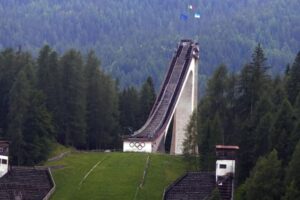
 The finish line for both races, located in Zuel, the venue was built for the 1956 Games and is famous for once having been described as ‘the most beautiful ski jump in the world’. Although no longer used for ski jumping, this elegant architectural monument, now restored, welcomes athletes at the finish line.
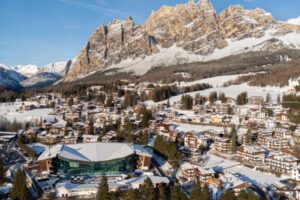 The emblem of the VII Winter Olympic Games in 1956 (where the ice hockey and skating events, as well as the opening and closing ceremonies, took place).
This venue has been refurbished to host the curling and para-curling competitions at the 2026 Games, further cementing its central role and prestige.
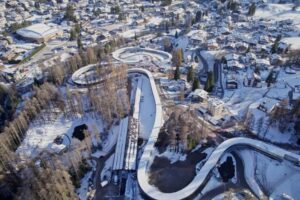 This historic track, dating from 1956, is named after the multi-medal-winning Olympian Eugenio Monti, known as ‘the Flying Red’. Recently refurbished for the 2026 Games, the venue is ready to host bobsleigh, skeleton and luge competitions, standing out for its technological innovation and sustainability.
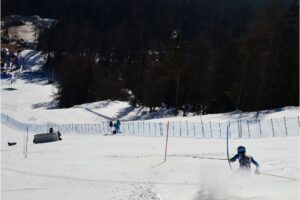 A wooded hill at the foot of the Tofane Mountains, renowned for its magnificent views of Cortina and the Ampezzo Dolomites. Home to the Col Drusciè Mountain Hut and the “Helmut Ullrich” Astronomical Observatory, it serves as a hub for the Freccia nel Cielo cable car. In 1956, it hosted the men’s and women’s alpine skiing slalom competitions.
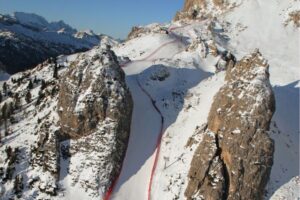 The famous slope is one of the most iconic downhill runs in the world. Having previously hosted the alpine skiing events at the 1956 Winter Olympics, it has been a regular fixture on the Women’s World Cup circuit for decades and will host the women’s alpine skiing events at the 2026 Winter Olympics.
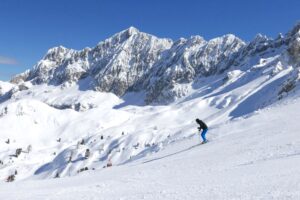 The Faloria-Cristallo ski area, accessible by cable car from the centre of Cortina, offers breathtaking views of the valley. The Ilio Colli slope hosted the men’s giant slalom at the 1956 Winter Olympics.
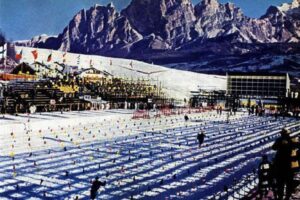 The Stadio della Neve was a temporary sports venue in Cortina d’Ampezzo, built for the VII Winter Olympic Games held in 1956. The venue hosted the cross-country skiing events< 1 > and the cross-country skiing portions of the Nordic combined competition. The course ran through the town’s cross-country skiing area, which boasts a long tradition in Cortina. These trails, like the route of the former Dolomites Railway toward Dobbiaco, offer picturesque scenery with views of Monte Cristallo and the Three Peaks of Lavaredo.
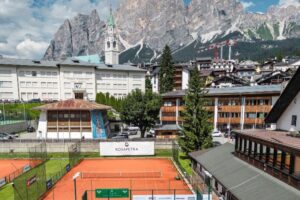 It was the highlight of the hockey matches in 1956. An interesting fact is that these were the first Olympics in which the matches were played on an artificial hockey pitch.
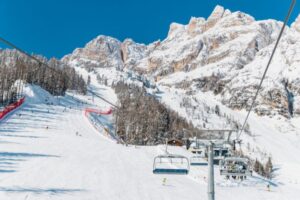 The slope hosted the women’s downhill and giant slalom events during the VII Winter Olympic Games, held in Cortina d’Ampezzo in 1956; built on the Tofane mountains, temporary stands were erected at the finish line for the event, with a capacity of 6,760 spectators.